Join on WhatsApp
Get the latest updates directly on WhatsApp – motivation, news & more!
 Join On WhatsApp
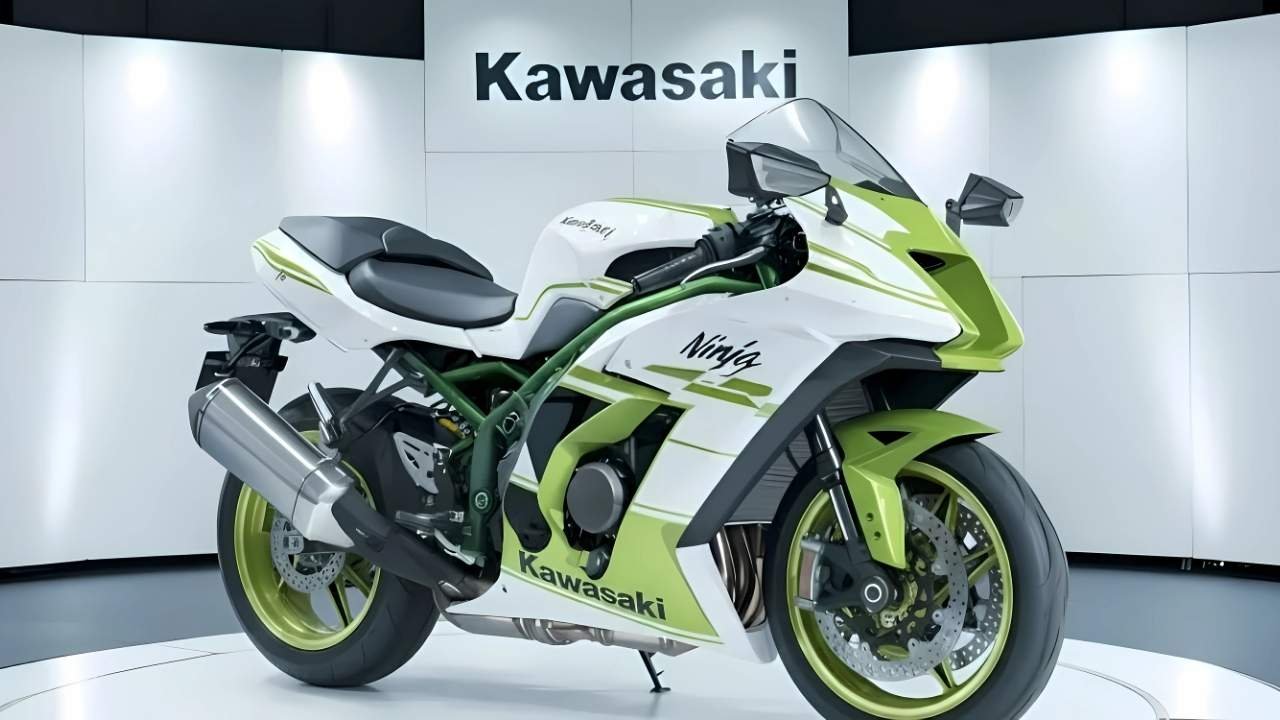
The Kawasaki Ninja H2R isn’t just a motorcycle it’s a high-performance machine built to break barriers. For 2025, Kawasaki has sharpened its most extreme track-only weapon with subtle design tweaks, updated electronics, and the same supercharged powerplant that’s earned it the reputation as the fastest production bike on the planet. With over 300 horsepower and cutting-edge aerodynamic engineering, the H2R is in a class of its own.
Supercharged Power That Redefines Speed
At the core of the 2025 Ninja H2R is a 998cc inline four-cylinder engine, bolstered by Kawasaki’s proprietary centrifugal supercharger. This isn’t just about raw displacement it’s about forced induction precision. The result? A staggering 305.75 bhp at 14,000 rpm.
The supercharger, developed in-house by Kawasaki Aerospace, can spin up to 130,000 rpm, force-feeding air into the engine at massive pressure. What this translates to is instant throttle response, ferocious acceleration, and a top speed that exceeds 400 km/h (250+ mph) under the right conditions. This is not street-legal, and that’s the point. The H2R is purpose-built for closed circuits and straight-line records, not stoplight drag races.
Electronic Rider Aids for Maximum Control
With that much power on tap, Kawasaki has wisely upgraded the bike’s electronic safety and performance systems for 2025. The compact Inertial Measurement Unit (IMU) now provides six-axis feedback, giving the onboard computer real-time data on lean angle, pitch, roll, and yaw.

This powers advanced features like:
- Kawasaki Cornering Management Function (KCMF)
- Kawasaki Intelligent ABS (KIBS)
- Slope-sensitive braking
- Wheelie control and launch control
- Engine brake control
The ride-by-wire throttle works in sync with a bidirectional quickshifter, allowing seamless upshifts and downshifts without clutch engagement. These systems don’t dilute the experience—they let riders push the H2R harder, with more confidence and precision.
Lightweight Design with Carbon Fiber Aerodynamics
Visually, the 2025 Ninja H2R remains unmistakable. Carbon fiber bodywork, including integrated aerodynamic winglets, helps generate downforce and reduce drag. The upper cowl, side fairings, and tail section are all optimized for airflow and cooling, while the Mirror Coated Matte Spark Black finish shifts tone depending on lighting part stealth bomber, part fighter jet.
Weight is kept low at 216 kg (kerb), impressive for a machine of this size and output. The single-sided swingarm, lightweight trellis frame, and redesigned carbon elements all work together to enhance handling without sacrificing straight-line speed.

Track-Focused Suspension and Braking
To match its straight-line speed with precision handling, the H2R uses top-tier components front to back. Fully adjustable Showa Balance Free Front Forks and an Öhlins TTX36 rear shock provide firm but responsive suspension tuning. Whether you’re tackling high-speed sweepers or hard-braking corners, the setup feels planted and confident.
Stopping power comes from dual 330mm Brembo discs with Stylema calipers up front, and a 250mm rear disc. The ABS system is performance-calibrated for track use, with minimal intrusion and maximum feedback.
A wide 200/55 rear tire and 120/600 front slick complete the racing-spec setup, offering grip and stability even under extreme acceleration or lean angles.
Built for Professionals, Not the Road
It’s important to note that the Ninja H2R is not street legal. There are no mirrors, turn signals, or license plate mounts. The exhaust system is a race-spec unit designed for maximum flow and performance. The riding position is aggressive, the noise is immense, and the response is immediate.

This is not a daily rider. It’s a precision-built, no-compromise hypersport machine designed for racers, collectors, and engineers who want to experience what happens when performance takes absolute priority.
Final Verdict
The 2025 Kawasaki Ninja H2R isn’t just the fastest production motorcycle in the world it’s a rolling showcase of what happens when aerospace engineering meets superbike design. Every element, from the supercharged engine to the carbon fiber bodywork, is focused on speed, performance, and control.
It’s loud. It’s extreme. It’s expensive. And for the lucky few who get to ride one on the track, it’s an unforgettable experience.